Skip to content




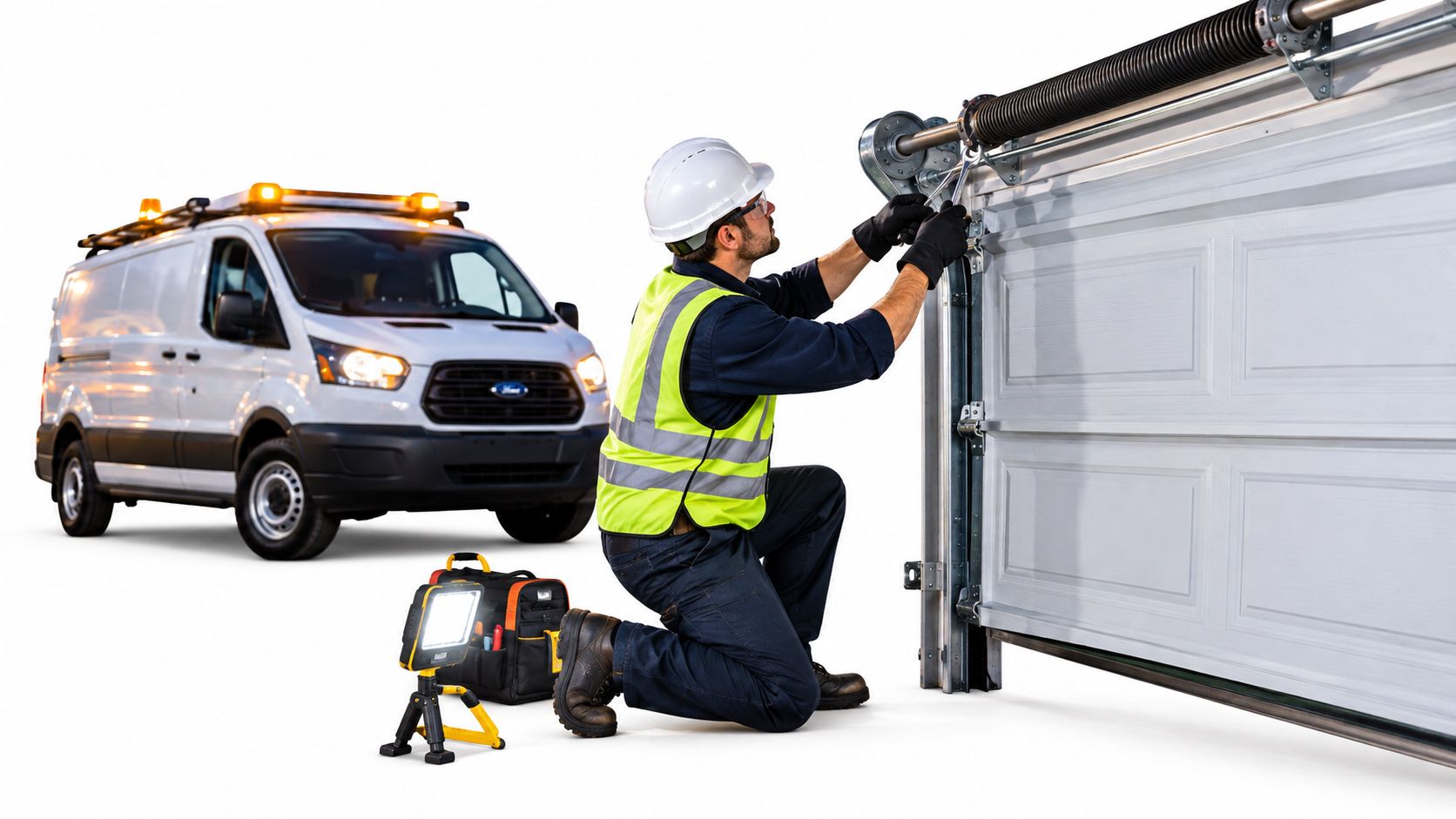
The garage door won't open, the car is trapped inside, and it's late enough that every repair decision feels expensive. Or the door is stuck halfway, leaving the house exposed while a damaged spring or cable hangs under tension. In either situation, the first question isn't “How fast can someone replace this?” It's “Is this unsafe to leave until morning?”
A 24/7 emergency repair call should start with triage, not pressure. The right technician helps you separate an immediate hazard from a frustrating but stable failure, make the area safe, and decide whether tonight's work should be temporary stabilization or a complete repair.
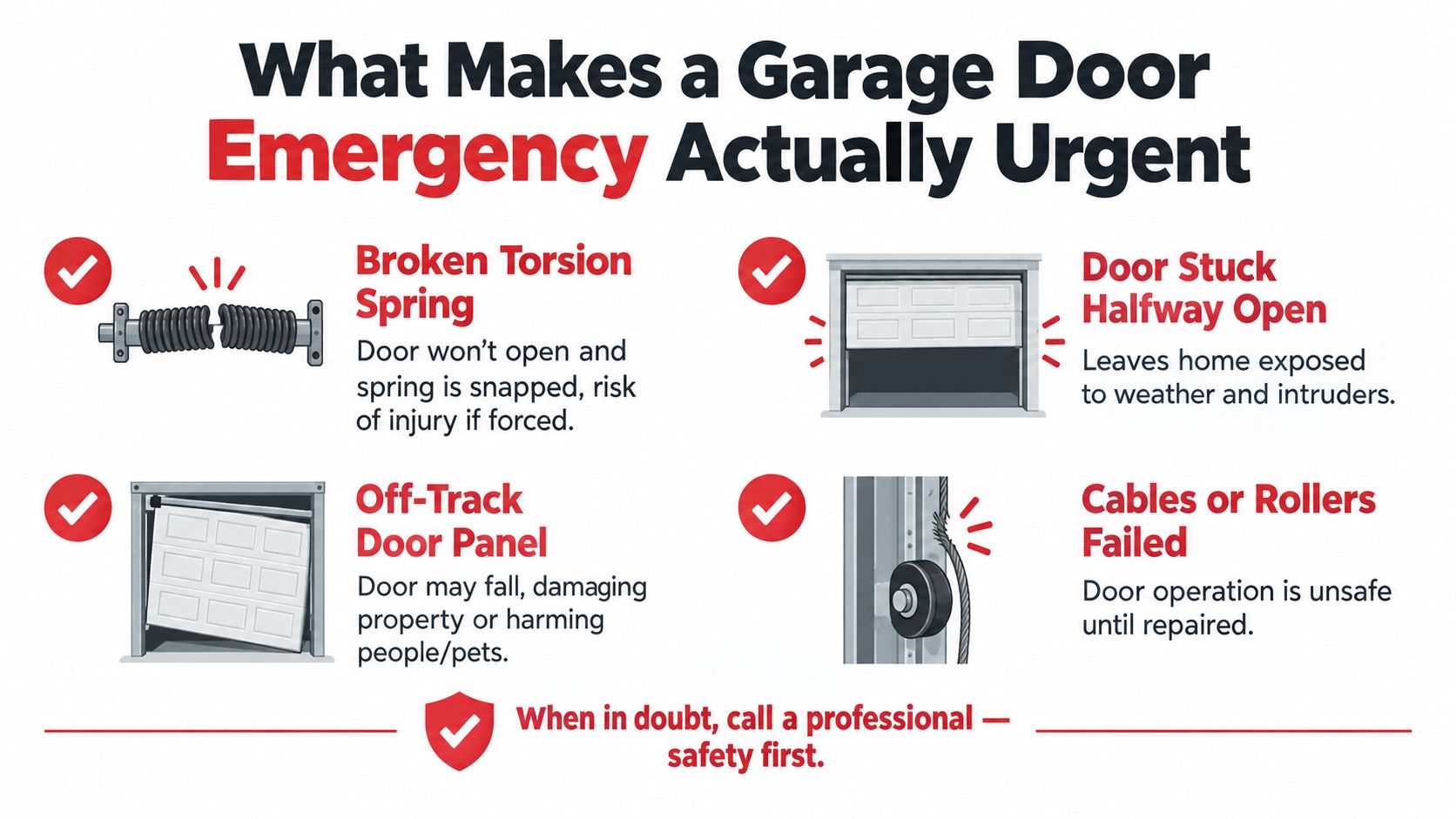
What Makes a Garage Door Emergency Actually Urgent
It's 11 p.m. and a homeowner presses the wall button. The opener hums, but the door stays down. That may be inconvenient, but if the door is fully closed, stable, and nobody needs to move a vehicle urgently, the safest choice may be to leave it alone and schedule service in the morning.
The situation changes when the door is halfway open, off its tracks, or closing without reversing. A raised door can expose the home to weather and unwanted entry. A panel that has left the track can shift or fall. A snapped spring or cable can make the door dangerously heavy and unpredictable. The U.S. Consumer Product Safety Commission connected automatic garage-door failures with child deaths and injuries, including 62 deaths and 49 injuries involving children under 15 from March 1982 through November 1996, followed by 23 additional child entrapment incidents involving death or injury between December 1996 and June 2003. The CPSC's garage-door safety report supports treating these failures as hazards, not ordinary inconveniences.
A quick decision test
Call for 24/7 emergency repair when any of these conditions applies:
- The door moves unexpectedly: A door that drops, closes by itself, or fails to reverse can crush a person, pet, or vehicle.
- The door is off track: Don't push or pull a shifted panel. Its weight may no longer be distributed correctly.
- A spring or cable has failed: The opener may still run, but it isn't designed to safely compensate for a broken counterbalance system.
- The opening is unsecured: A door stuck open can leave the garage and connecting areas exposed.
- Someone is trapped or access is critical: This includes a vehicle needed for an urgent trip or a light-commercial door blocking essential operations.
A closed door with a dead opener can often wait if the door itself is secure. A door that looks stable but has a separated cable, loose panel, or damaged spring should be treated differently. Use this emergency garage door guide to help identify the situation, but don't test a questionable door by repeatedly pressing the remote.
The wider emergency context matters too. The National Fire Protection Association's home-structure fire data reports an annual average of 328,590 home-structure fires during 2019 through 2023, with an average of 2,600 civilian deaths, 10,770 civilian injuries, and $8.9 billion in direct property damage each year. A garage door that won't open can slow evacuation or responder access. One that won't close can leave a damaged home unsecured. That's why the decision should focus on people, vehicles, access, and uncontrolled movement, not just whether the motor makes a noise.
Immediate Safety Steps Before the Technician Arrives
Start by keeping everyone away from the door. Move children, pets, and vehicles out of the opening, and don't stand beneath a raised or partially separated panel. If the door is leaning, crooked, or making structural noises, create a wider exclusion area and keep people from walking through the garage.
Next, stop using the opener. Repeated attempts can worsen a stripped gear, pull a damaged cable farther out of position, or make a door with a failed spring move unpredictably. If the door is closed and the opener can be safely unplugged without reaching beneath a moving panel, disconnect power. For a commercial door, the employer or responsible manager should use the site's energy-control procedure rather than improvising.
What you can check safely
Look from a distance. Note whether:
- The door is fully closed, partly open, or fully raised.
- One side sits higher than the other.
- A cable is loose, separated, or wrapped incorrectly.
- A spring appears broken or has a visible gap.
- A track is bent or a roller has escaped.
- The photo-eye lenses are visibly blocked or knocked out of alignment.
Take photos for the technician, landlord, insurer, or property file. Don't remove covers, straighten tracks with a pry bar, or lift a heavy door by hand. A torsion spring stores significant energy, and the red emergency-release cord doesn't make a counterbalanced door safe to handle when the spring or cable system has failed. If you need background on that mechanism, review this guide to the garage door emergency release cord, but don't pull it while someone is beneath the door or while the door is visibly unstable.
Practical rule: If you can't explain why the door is supported, don't try to move it.
Avoid the tempting shortcuts
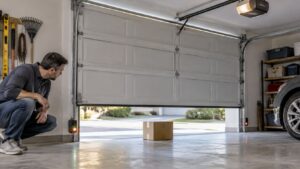
Never manually unwind a torsion spring, remove red counterbalance components, or place your hands between panels. Don't bypass photo eyes, tape down a safety sensor, or adjust force settings just to get through the night. The CPSC recommends testing an automatic opener with a 2-by-4-inch block placed flat in the door's path. If the door doesn't reverse properly after contacting the block, disconnect the opener until it's adjusted, repaired, or replaced. The CPSC opener safety guidance also places photoelectric sensors approximately 4 to 6 inches above the garage floor.
If water, smoke, or fire has affected the garage, leave electrical equipment alone and contact the appropriate emergency service first. For a commercial or multi-unit property, isolate the area and notify the responsible manager. OSHA's lockout and tagout tutorial explains why equipment must be shut down, isolated from its energy source, and protected from unexpected energization during service.
Common Emergency Fixes and What They Involve
A frightening failure doesn't automatically mean the entire door needs replacement. Most emergency visits begin with a focused inspection of the door sections, rollers, tracks, cables, springs, opener, fasteners, and safety devices. The technician's job is to identify the failed part and determine whether the surrounding system is still safe to use.
Off-track doors
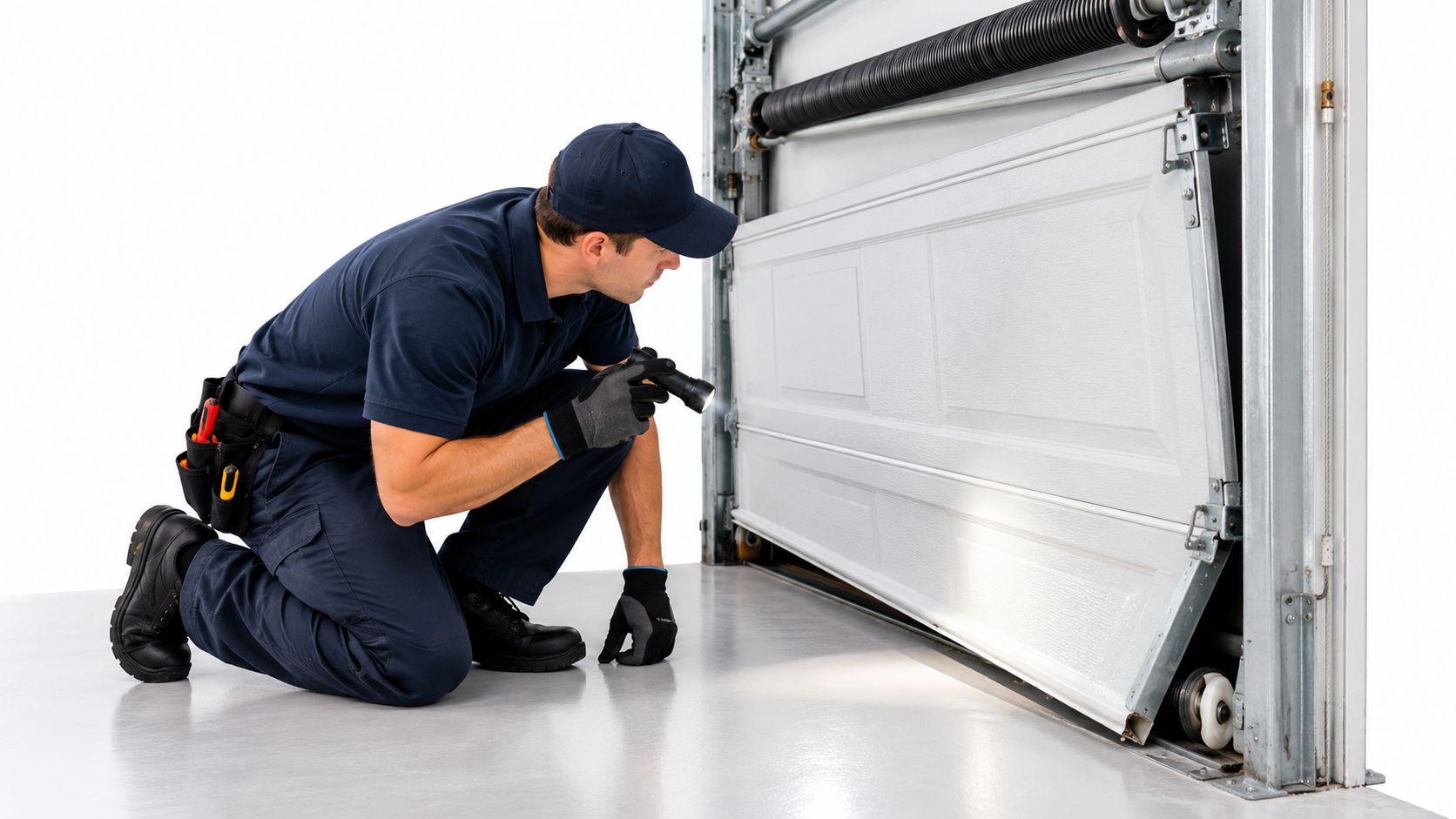
An off-track door usually shows a crooked panel, a roller outside the vertical track, or a door that binds on one side. Impact from a vehicle, worn rollers, loose fasteners, damaged hinges, or a cable that has slipped can create the problem. Forcing the opener can bend the track further and put more load on the remaining rollers.
The technician first secures the door, checks the sections and track for distortion, and inspects hinges, rollers, cables, brackets, and mounting points. If the panels and tracks remain sound, the repair may involve resetting the rollers, correcting alignment, replacing damaged hardware, and testing the full travel cycle. If a panel or track is crushed, stabilization may be the only safe after-hours outcome until the correct replacement is available.
Broken springs and cables
A broken torsion spring often leaves the door extremely heavy, while a failed extension spring, cable, or drum can make one side drop or pull away from the frame. The opener may still run, but it can't safely replace the counterbalance system. Continuing to operate it can damage the motor, trolley, or door sections.
A qualified technician checks both sides of the counterbalance system, the drums, cables, end bearings, shaft, brackets, and spring configuration. Replacing only the visibly broken cable without correcting the underlying alignment or spring condition doesn't solve the risk. Spring work requires specialized tools and knowledge. DASMA guidance emphasizes preventing accidental component removal before tension is released and identifies warning labels and specialized equipment as safeguards.
Opener malfunctions
A dead opener can result from a failed circuit board, worn gear, damaged trolley, incorrect travel limits, wiring trouble, or a misaligned photo eye. The door itself may be perfectly serviceable, or the opener failure may be a symptom of excessive door weight or mechanical binding.
The technician separates the opener problem from the door problem. They check manual balance only when the door can be safely handled, inspect the rail and trolley, verify travel limits, examine sensor wiring and alignment, and test automatic reversal. CPSC guidance says the reversing feature should be tested monthly and that the door should reverse within two seconds after contacting a 2-inch-high test block. The CPSC proposed opener safety rules also describes reopening within 30 seconds when the mechanism detects that the door hasn't fully closed to the floor.
A proper emergency repair restores safe operation, not just movement. The final check should include spring and cable integrity, track alignment, attachment fasteners, travel limits, photo eyes, and reversal response.
Response Times, Pricing, and What to Expect After Hours
After-hours service has two separate questions: How quickly can someone make the situation safe, and how much work should happen tonight? Those answers aren't always the same. A technician may secure a door that's off track, disconnect a failed opener, or protect a commercial opening first, then return during normal hours for a part-specific repair.
Greater Cleveland response time depends on technician location, traffic, weather, call volume, access details, and whether the door is residential or light commercial. A responsible company should avoid promising an exact arrival before learning what happened. Give the dispatcher the door's position, visible damage, whether anyone is trapped, and whether the garage is part of a business or multi-unit property.
Stabilization versus permanent repair
| Option | What it accomplishes | When it makes sense |
|---|---|---|
| Emergency stabilization | Secures the opening, limits further movement, and reduces immediate exposure | The door is unsafe to operate or the correct part isn't available |
| Complete repair | Replaces failed components and verifies the whole system | The technician can safely complete the work and test it properly |
| Next-day appointment | Avoids unnecessary after-hours labor when the door is stable | The door is closed, secure, and no urgent access issue exists |
The invoice may separate dispatch, diagnosis, temporary securing, labor, parts, and any after-hours charge. Ask for those categories before approving work. A vague promise to “get it working” isn't enough. You should know whether the estimate covers a spring pair, cable set, rollers, track correction, opener component, or only temporary securing.
That distinction matters for households with limited cash available. A HomeServe homeowner survey found that 80% of homeowners experienced a home-repair emergency during the previous year, while one-third had $500 or less available to pay for it. An honest technician should explain what can wait without compromising safety and what cannot. Speed matters, but research on why lead response time matters also reinforces a practical point for service companies: quick contact should lead to clear information, not rushed approval.
For a stable door, 24-hour garage door service can mean scheduling the right repair rather than sending someone to replace parts unnecessarily. For an exposed, unstable, or trapped-access situation, it means prioritizing safe access and control of the failure.
How to Choose a Reliable Emergency Service Provider
At 11 p.m., with a door stuck half open and someone you have never met saying they can be there in 30 minutes, the job is not just getting the door moving again. It is deciding whether this company is safe to let onto the property and whether the proposed fix matches the actual problem.
A reliable after-hours provider makes verification easy before tools come out. You should be able to get the business name, phone number, service area, and a written outline of charges without a struggle. The Ohio Attorney General's consumer guidance warns consumers to check a contractor's identity, avoid cash-only deals, and be cautious with missing estimates or large upfront demands. That matters even more during an urgent call, when people are tired and more likely to approve work they do not fully understand.
Before you approve anything, get answers to a few plain questions:
- Who is coming? Confirm the company's legal name and ask whether the technician is insured.
- What is the visit fee tonight? Ask for the service-call charge and any after-hours fee in writing.
- What failed? A technician should identify the broken part before recommending replacement.
- What does the estimate cover? Look for labor, parts, fees, temporary securing, testing, and anything excluded.
- What warranty applies? Parts and labor often have separate coverage. Get that in writing.
- How do you take payment? Use a traceable payment method and do not pay the full amount before the work is done.
Low price alone is a weak filter. A careful company explains whether the visit is for temporary securing, a full repair, or diagnosis only. That distinction matters. I have seen homeowners approve spring, cable, and opener work in one visit when the immediate need was only to secure the opening and schedule the rest in daylight.
Documentation helps if questions come up later. Take photos before work starts. Keep the estimate, invoice, part details, and any messages about return visits. For rental or commercial properties, record the manufacturer, model, visible defect, shutdown steps, corrective action, and post-repair test. OSHA does not have one federal standard written only for overhead doors, so a clear service record is more useful than a vague invoice that says “fixed.”
For maintenance, follow the manufacturer's instructions and the door's actual use. A heavily cycled loading door needs a different schedule than a lightly used residential door. Emergency work also may not erase permit duties. In Cleveland, the city's permit requirements state that if emergency replacement or repair has to happen immediately, the permit application must be filed by the next working business day.
How Danny's Garage Door Repair Handles After-Hours Calls
A useful 24/7 response has three stages. First, the dispatcher identifies whether the door is unsafe, unsecured, inaccessible, or unable to open. Second, the technician controls the hazard before attempting a repair. Third, the company explains the permanent options and tests the complete system before handing it back.
Danny's Garage Door Repair serves Greater Cleveland with round-the-clock residential and light-commercial service. Its work includes spring and cable replacement, off-track corrections, opener troubleshooting, safety tune-ups, and complete repairs for major brands. The practical value of that model is not just availability. It's the ability to match the response to the actual failure, whether that means securing a door overnight or completing a tested repair during the visit.
What a careful after-hours visit should include
A professional visit should leave you with answers, not just a moving door:
- A clear diagnosis: The technician identifies the failed component and checks related parts that may have been damaged.
- A safety decision: The company explains whether the door can remain closed, must stay disconnected, or needs immediate stabilization.
- A written scope: You see the recommended repair, optional work, parts, labor, and applicable fees before approval.
- A complete test: The technician verifies balance, travel, track movement, fasteners, photo-eye alignment, and automatic reversal.
- A follow-up plan: If temporary work was necessary, you know what remains, who will return, and what the next visit involves.
The same discipline matters for businesses that need dependable service acquisition and follow-up. Resources on garage door lead generation often focus on connecting customers with providers, but the customer's real test begins after the phone rings. A lead becomes a successful service experience only when the provider communicates accurately, arrives prepared, documents the repair, and leaves the door safe.
For homeowners, the best outcome isn't always a full replacement that night. It may be a secure closed door, a disconnected opener, and a scheduled return with the right part. When the failure involves a falling panel, broken counterbalance system, failed reversal device, or blocked emergency access, delaying service can create a larger problem. Good emergency work respects both sides of that decision, acting quickly when risk is high and avoiding unnecessary after-hours work when the door is stable.
Danny's Garage Door Repair provides 24/7 residential and light-commercial emergency service across Greater Cleveland, including diagnosis, stabilization, spring and cable repair, opener service, and off-track corrections. If your door is unsafe, stuck open, or blocking urgent access, visit Danny's Garage Door Repair to request help and get a clear repair plan.